Marine Special Products

Marine Air Conditioning | Sanitation | Electronics Installation | Essex CT

header-right-tag
860 718 0100emailfacebookli

  • Home
  • About
  • AC/Heat
  • Electronics
    • Marine Electronics – What’s New?
  • Solar
  • Sanitation
  • Maintenance
  • Blog
  • Contact

Marine Electronics News from the 2026 Boat Show Circuit

March 23, 2026 By D.G. Fitton

From the opening bell of the Atlanta Boat Show in early January through the Hartford Boat Show in late Jan/early Feb right up to this weekend’s Palm Beach Boat Show, the winter show circuit has delivered a clear message: boating is getting smarter, more connected, and more power-hungry (in a good way). The marine products and systems that support that demand are evolving fast. 

For Marine Special Products Group clients, this translates into better navigation and sonar, cleaner installs, more reliable onboard power, and solar + battery systems that feel less like “add-ons” and more like a true energy platform.

Following is a roundup of the most interesting developments and product themes we’ve seen or read about emerging from this winter’s shows—especially as they relate to marine electronics, power management, and solar charging.

Multi-Function Displays keep leveling up (clarity, speed, integration)

The headline electronics story of the winter seems to be that helm displays and networked systems continue to consolidate — meaning more capability from fewer boxes, and tighter integration across radar, sonar, autopilot, digital switching, and entertainment.

At the Miami International Boat Show, multiple manufacturers highlighted new and noteworthy display electronics that boaters should prioritize considering. Standouts included Furuno’s TZtouchE and the broader Furuno NavNet TZtouch series ecosystem, which continue to push the category forward with faster processors, improved touchscreen usability, and deeper integration across radar, sonar, and charting.
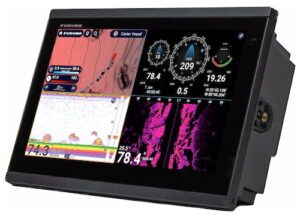
These systems are designed to operate as either compact standalone navigation units or as part of a larger integrated helm network, making it easier for boat owners to scale a system over time rather than replacing everything at once.

Furuno also highlighted continued enhancements to their radar integration with the Furuno DRS4D‑NXT and related Doppler radar platforms, which pair directly with the TZtouch ecosystem to deliver improved target separation, collision awareness, and bird-finding capability for offshore anglers.

What this means for owners: if your current system is 5–8+ years old, the jump in screen readability, processing speed, networking, and sensor fusion can be significant. And if you’re planning radar + sonar + autopilot upgrades, it’s worth designing the system as a single integrated architecture rather than buying components “one at a time.”

Sonar and transducers: higher resolution, more specialized use-cases

Even at consumer-facing winter shows, education around sonar and transducers remains front-and-center—because the technology (and the choices) have exploded. Multiple Discover Boating show guides promoted seminars that specifically cover chart plotters, fish finders, transducers, wiring, and autopilots—exactly the areas where buyers often need practical clarity before purchasing. 

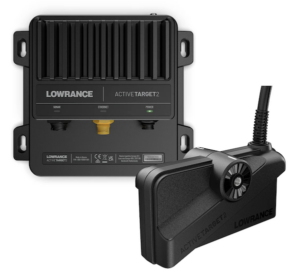
From a product standpoint, Lowrance rolled out its ActiveTarget® 2 XL live sonar system, which earnedLowrance ActiveTarget an NMMA Innovation Award for delivering ultra-clear, wide-angle real-time sonar views from a single transducer—highlighting meaningful advances in situational awareness and fish-tracking performance for anglers evaluating a sonar upgrade versus a broader electronics refresh.
What this means for owners: the “best” sonar setup depends on how you boat—coastal cruising vs. offshore, trolling vs. vertical jigging, sail vs. power, single station vs. dual station. The right transducer selection and installation approach can matter as much as the head unit brand.

Power systems are moving toward 48V, lithium-first “house power” architecture

One of the most consequential trends is literally electrical. The industry is rapidly shifting from traditional 12V/24V, generator-dependent setups toward higher-capacity battery banks, smarter distribution, and more efficient conversion.

A key datapoint: NMMA’s Miami Innovation Awards highlighted Navico Group’s Fathom e-power system, described as an integrated 48-volt lithium-based approach designed to extend time away from charging sources and support growing onboard electrical loads (including air conditioning) without relying solely on a generator.

What this means for owners: if you’re adding large loads (multiple displays, radar, refrigeration upgrades, electric cooking, AC at anchor), it’s time to think holistically—battery chemistry, charging sources, cabling, overcurrent protection, ventilation, monitoring, and DC-DC conversion. Done right, this is where boats become dramatically easier to live with.

Solar isn’t “just panels” anymore—it’s an energy strategy

Solar at the winter shows continues to evolve from “trickle charging” into a real contributor to daily energy needs—especially paired with lithium and smart regulators. That’s true in both retrofit markets and on newer boats that are being built with solar readiness in mind.
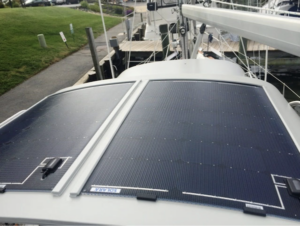
Solara walk-on solar panelsAt the Hartford show, Solara showcased their Power M walk-on solar panels which solve for limited onboard energy and reliance on noisy generators by providing high-efficiency, marine-rated solar that’s strong enough to be walked on and integrated seamlessly into deck surfaces. They deliver durable, continuous renewable power to house batteries, reducing charging downtime and extending time at anchor while enhancing safety and convenience on board.

What this means for owners: the best solar upgrade is designed around your real usage—overnights on the hook, refrigeration duty cycle, inverter loads, and seasonal sun angles. Panel selection is important, but so are mounting, wiring runs, controller selection, shading mitigation, and battery integration.

How Marine Special Products Group helps you turn “boat show ideas” into a reliable system

If you came home from the winter shows with a shortlist—new displays, radar/sonar, upgraded batteries, solar charging, or cleaner power distribution—MSPG can help you:

  • Map your system architecture (today vs. where you want to be in 2–3 seasons)
  • Right-size batteries + charging sources (shore power, alternators, solar, DC-DC)
  • Design a clean network and wiring plan that supports future expansion
  • Install and commission so everything plays nicely together—quiet power, solid connections, and dependable performance

Despite all the rainy, cold weather so far this Spring here in Connecticut, the fact is that boating season is just around the corner. We’ve begun installations and are booking out so contact us today if you would like to discuss electrical, marine electronics or solar energy platform systems, please contact DG Fitton of Marine Special Products Group. DG would be happy to talk with you about upgrading or refitting the marine electronics on your vessel. 

Filed Under: Boat System Upgrades, Marine Electronics Tagged With: Marine Electronics, Marine Solar, Navigational Electronics

Serving our Customers during the COVID-19 Connecticut Shutdown

March 24, 2020 By D.G. Fitton

On Monday, March 23th, Connecticut Governor Ned Lamont took much-needed action to “flatten the curve” and help Connecticut residents work together to contend with and ultimately beat the Novel Coronavirus and Covid-19. 

By issuing executive order 7H and imploring workers outside of only the most essential Connecticut businesses to “Stay Home, Stay Safe”, Lamont is hoping to remove the human connectivity which this virus needs to spread. 

Here at Marine Special Products Group – we support these decisions. We also realize that as an Essential Business that can continue to operate during these uncertain times, we have some responsibilities to our employees, our customers, and the community. 

First, we will employ the generalized safe interaction practices as per the CDC. Further, we have reviewed the OSHA guidelines for operating a business during the Covid-19 outbreak and will adhere to all recommended practices.

Having considered the general recommendations from both the CDC and OSHA, there are some specific actions we will take as it relates to our business.

  • If a vessel is stored or berthed in a marina that has restricted access during the Connecticut Coronavirus Stay Home, Stay Safe period, we will not be able to work on that boat until the marina lifts their restriction. However, if the boat is trailered and can be transported to our facility in Essex, we can discuss that as an alternative.
  • We request that all boat owners notify us prior to our working on their boats if anyone has accessed the vessel in the previous 10 days. This includes owners, their families and any dock or marina workers who have access to the vessel. We will take additional precautions and properly sanitize surfaces before and after our work.
  • While we normally are happy to have customers join us below decks for our estimate development sessions, given the logistics of Social Distancing, we can’t allow that during this timeframe.
  • For new equipment installs, Sea Trials and In-person orientation sessions will have to be postponed until after the Connecticut Coronavirus Stay Home, Stay Safe period. 

Finally, given the uncertainty of these times and the extreme virality of the Novel Coronavirus, we also reserve the right to postpone or decline to take on any new work if the circumstances surrounding a specific job seem inconsistent with safe, sanitary hygiene protocols required to keep everyone safe.

Thank you for your support of the Marine Special Products Group. We realize that being allowed to work during this timeframe carries responsibilities which we take very seriously. If you would like to discuss a project on your boat, please let us know via either email, calling, or texting DG Fitton, MSPG owner, on 1 (860) 718-0100.

Filed Under: About MSPG, Essex, CT

USGC seeks input on modernizing maritime navigation

July 16, 2014 By D.G. Fitton

Do you have thoughts on how maritime navigation can be improved? The US Coast Guard is right now seeking input. Here is a link to their survey on this issue which impacts commercial and recreational boaters alike.

Filed Under: Uncategorized Tagged With: Marine Electronics, Navigational Electronics

Boat AC – dealing with an HPF code

July 15, 2014 By D.G. Fitton

You and your lady are meant to take a cruise across the Sound for a well-deserved, Wife is Hot thumbnailoverdue getaway weekend. You’ve spent the last two days geting the boat wife-ready and now, after an unanticipated delay at the office, you are on your way to the marina. Your wife is already there by now so you give her a call to let her know you are on the way.
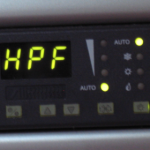
“I’m hot,” you happily hear her say. “I know you are, baby and I can’t wait to shove off,” you cheerily reply. “No, I’m hot. As in the air conditioning on your damn boat isn’t working and I’m not going anywhere.”

Thinking quickly, you pull into the nearest florist and grab whatever bouquet is readily available. You then high-tail it to the marina so you can get this situation sorted. Upon arrival, a quick visual inspection verifies what you feared:  your wife is hot. “I think that stifling air below has re-awakened that smell from last summer,” she says as things are going from bad to worse. You hand your wife the bouquet, which gets you half a smile and you pour her a weak gin and tonic (no need to fuel this fire), eliciting another quarter smile. “I’ll get this fixed” you confidentially offer up as you head below to see what’s what.

Armed with your smartphone and a super-human drive to get the Boat AC working, you make a cursory examination of the air conditioning controls and discover the dreaded HPF code – a High Pressure Fault. For the uninitiated, a high pressure fault typically indicates a probHPF thumbnaillem with water flow. Your Google search tells you to check and make sure water is flowing out of the system. Easy, peasy, right? You turn the system on, head topsides, and immediately lose the additional quarter of a smile by instinctively patting your wife on the head as you go forward to inspect the cooling water exit.

As you move forward, you hear the trickle indicating water is flowing out, and a visual inspection validates this. However, rate of flow could be the issue so research the proper flow-rate for your unit (the average is about 3.5 gallons per minute) and then use a measured container and stopwatch or watch sweep hand to make sure you the flow is within the proper parameter (this would also be a good time to make sure the water is devoid of any debris or coloration; it should be clear). If the flow isn’t adequate, you need to start checking on things which might be impacting flow. Make sure the seacock for the sea-water intake thru-hull is fully open, clear the sea-water intake strainer of any debris.

If this doesn’t resolve your HPF issue, there may be a problem with your pump. Before you start pulling it apart (and giving up any hope for that Long Island weekend), you might try backflushing the system to eliminate any air or debris which is preventing the pump from being fully primed. You’d be surprised at the amount of clogging just a season’s worth of sediment or contaminants can create. To perform the backflush, you simply put your dock hose in the output and turn it on. Depending upon your dock situation, falling overboard during this procedure may get at least that quarter smile back you lost with the head pat.

If after trying these trouble-shooting steps you still have an HPF code, there may be some other aspects of your system that need to be addressed. Because of the variety of possible causes, it very well may be time to call someone like me.  I do make emergency visits and my number is 1 (860) 718-0100; don’t hesitate to call.

Filed Under: Uncategorized Tagged With: Boat AC, Boat Maintenance

Welcome to our website

May 16, 2014 By D.G. Fitton

Greetings! Thanks for stopping by our website.

I am DG Fitton and Marine Special Products Group, LLC is my company. While many people and organizations have helped me shape it over the years, and I rely on vendors for the products and technical assistance as well as my talented employees, when you have dealings with MSPG you are dealing with me.

Therefore, you’re going to see a quite a bit of me in this new website of ours: my background, my knowledge of marine systems, my sense of humor (this is about boating, not brain surgery!) and my professionalism. But you’ll also see a lot of you in the new site because without our loyal customers, we wouldn’t have survived for the last eight years.

We re-launched this site for a few reasons. First, I wanted customers and prospects to get the full picture on what we do here at Marine Special Products Group, LLC. Many of our customers know us from what we have done for them specifically, which usually is limited to one of the three areas in which we specialize: boat AC/heating, marine sanitation and navigation or entertainment electronics. But more often than not, I’ll bump into a previous customer while working on someone else’s boat only to hear “I didn’t know you did that.” So this new website will help customers and prospects alike to learn about what we do.

Secondly, in the more than two decades I’ve been working on recreational and commercial boating systems, I’ve seen the good, the bad and the ugly (sometimes the very, very ugly!). I’ve developed a body of knowledge that I’d like to share with my boating friends. An example is my Spring Commissioning blogpost, which was developed from a marine system’s perspective; not too many of these re-commissioning checklists include thoughts on mud wasps and mice in refrigerator coils. If you’re interested in this type of information, bookmark my blog or subscribe to my RSS feed.

Finally, like most who read this, I was bitten early on by the boating bug and have remained addicted to all things nautical: the boating lifestyle, humor, noteworthy tidbits, helpful hints, etc. This site will be a place for me to share some of the interesting, educational and (more often than not) funny stuff I find out there on the Internet that relates to boating. Again, this will flow from our blog so stay connected to that if you enjoy this sort of content.

So again, thanks for stopping by. If you have any suggestions, comments or questions, email me directly. I’d love to hear your feedback.

Happy boating,

DG

Filed Under: Uncategorized

Spring Recommissioning Checklist

May 12, 2014 By D.G. Fitton

Spring. I’ve often said that, for boaters, spring truly arrives that second warm weekend in April, when a boat owner starts to experience visions (pangs?) of being out there; feeling the warm sun on their skin, the salty spray on their face and, hopefully, not hearing the clunk or clank of something going awry.

If there is one thing I’ve learned over the decades, it’s that when it comes to boats, an ounce of prevention is certainly worth a pound of cure. Said another way, in every single instance I have experienced, the cost of preventative maintenance is a fraction of the price of an in-season repair or replacement. Not to mention the loss of some portion of your boating season.

This might explain why everybody and their brother publishes a ‘Spring Commissioning Maintenance Checklist’ of one sort or another. I have nothing against these checklists; they definitely provide boaters with an attack plan for getting their vessels back in the water. Some of the lists are really quite good, such as this one from SeaTow. But at the end of the day, most seem like slight variations off the same themes; collections of generalities that may become rote and, therefore, less effective.

But what good is criticism if we don’t try to make improvements, right? To this end, I’m offering up a Spring Commissioning Checklist but from the perspective of what I do for a living: Recreational and Commercial Marine Systems. Here are some of the things you should be thinking about if you want to avoid having to call someone like me just prior to a long, hot holiday weekend.

Marine Air Conditioning and Heating
1) Check the seawater strainer. If seawater flow through the system is not properly maintained, the amount of heat transferred will be reduced which greatly impacts system performance and system strain. To avoid this, check the seawater strainer for debris or for changes from freezing temperatures. In addition to doing this at commissioning, the saltwater flow should be checked at least monthly during the summer; this will vary depending on the quality of water that a boat sails or cruises in.

2) Clean your return air filter. Proper and efficient system performance requires an unobstructed flow of air to the evaporator. In-season, inspect the return air filter and clean or replace it as necessary; you’ll find it on the blower/evaporator assembly and, possibly, another built into the return air grill assembly. The proper filter material for a marine environment is different than that typically used for household or commercial applications. These filters are the first line of defense against an obstructed evaporator coil, a situation that requires potentially costly chemical and mechanical treatments to resolve.

3) Secure fixings and connections. By their very nature, systems on boats vibrate and shift about. Checking and, if necessary, tightening system fixings and electrical connections is a key step during spring commissioning. While you are doing this, you should also inspect hoses, coils and other piping for wear or leaks.

4) Check for mold and mildew formation. These contribute to unpleasant and unhealthy conditions aboard any vessel. Once mold or mildew take hold, traditional cleaning methods typically do not resolve the problem. We have a number of solutions available to overcome mold and mildew.

The Head and Holding Tanks
1) Inspect holding tank vents. Annual inspections are critical. Check for obstructions at the overboard fitting for the vent; very frequently spiders or mud wasps chose the narrow opening of a holding tank vent overboard to make their nest. Holding tank vent filters (if your vessel is fitted with one – and It SHOULD be) need replacement in order to function properly.

2) Remove holding tank accumulation. Even frequently emptied holding tanks begin to accumulate sediment that, if not addressed, will continue to gather and reduce tank capacity. At least every other year, this sentiment must be reduced. It can be cleaned out by hand using inspection ports or, more easily and certainly more genteel, it can be eliminated via an enzymatic cleaning which liquefies tank buildup and enables you to flush it during pump-out.

3) Check the head system for proper function. Are the seals working? Does the bowl clear when the head is activated? Does the bowl rinse properly? How long does your VacuFlush system hold a vacuum? Nothing disturbs a night of rest on board like the constant cycling of a vacuum generator; without a flush, the system should hold a vacuum for 8 hours, leaving you well rested and ready for the day.

Navigation and Sounding Electronics
1) Current software. Verify that your navigation systems operating software and electronic charting data are current. Without the most current software in your system, you are in danger of relying on out of date navigational information, incorrect GPS data, incorrect tide, current or celestial data and possibly be missing useful new features.

2) Inspect vessel for rodent droppings. Finding evidence of plastic and rubber-hungry rodents should translate into a raised vigilance in your wire, pipe and tube inspections. Mice love lining their nests with the plastic/rubber insulation in electrical wiring and, seemingly, the heavier the gauge the better they like it.

3) Evaluate and then service your batteries. They are the heart of your boat’s electrical system so they deserve an annual check up. Has the battery been drained during storage time? Is it holding a charge? How old is the battery? – this is a good time to remind yourself. Once you know it will stand up to another season, make sure terminals and connectors are clean and secure. Check battery fluid levels and top off with distilled water, if necessary. Finally, wipe the battery top clean of any water or residue that could become a conductive path.

Refrigeration
1) Check the seals. Maintaining proper cold box temperatures becomes a big challenge when seals are faulty. Make sure insulation is clean and adheres properly to the intended surface. Rodent droppings should be a red flag here as well.

2) Clean the coils. As with boat AC, evaporator coils must be kept clean to promote operational efficiency as well as prolong the coil life.

If you are uncertain or just don’t have the time, we are available to perform many different aspects of Spring Commissioning Maintenance. We’re also happy to take a moment and answer questions you might have about any of the above. I’ll close by saying this: Whether you do it yourself or have someone else perform it, Spring Commissioning Maintenance definitely falls into the “pay me now or pay me later” camp.

Filed Under: Uncategorized Tagged With: Boat AC, Boat Maintenance, Marine Electronics, Marine Refrigeration, Marine Sanitation

Tell us all about it …

Does your head hurt? Is your wife hot? Are you tired of asking for directions? We hear you. We can help with any marine systems problem you might have so fire away.

Contact Form

What’s New

Serving our Customers during the COVID-19 Connecticut Shutdown

On Monday, March 23th, Connecticut Governor Ned Lamont took much-needed action to “flatten the … [Read More...]

Welcome to our website

Greetings! Thanks for stopping by our website. I am DG Fitton and Marine Special Products Group, … [Read More...]

Marine Electronics News from the 2026 Boat Show Circuit

From the opening bell of the Atlanta Boat Show in early January through the Hartford Boat Show in … [Read More...]

Our Guide to Holiday Boating Gift Guides

With the Holiday Season upon us (where did the year go?!), it’s time to celebrate your favorite … [Read More...]

Weather Info

Find more about Weather in Essex, CT
Click for weather forecast

Our Flotilla

Two decades of working with the southern New England boating community has led us to pick up many friends, mentors, and business partners along the way. Many of the people we know, trust, and enjoy working with can be found among these fine groups, guilds, or businesses.

Chester Boat Basin
Chester Point Marina
Crocker’s Boatyard
Petzold’s Marine Center
Oak Leaf Marina

Saybrook Point Marina
ABYC
CMTA
NMEA
RIMTA

Connect With Us

Marine Special Products Group, LLC
147 Dennison Road
Essex, CT 06426
Phone 860-718-0100
Fax 203-413-6244
DG@marinespecialproducts.com

Copyright © 2026 · Marine Special Products on Genesis Framework · WordPress · Log in